 Kelpie
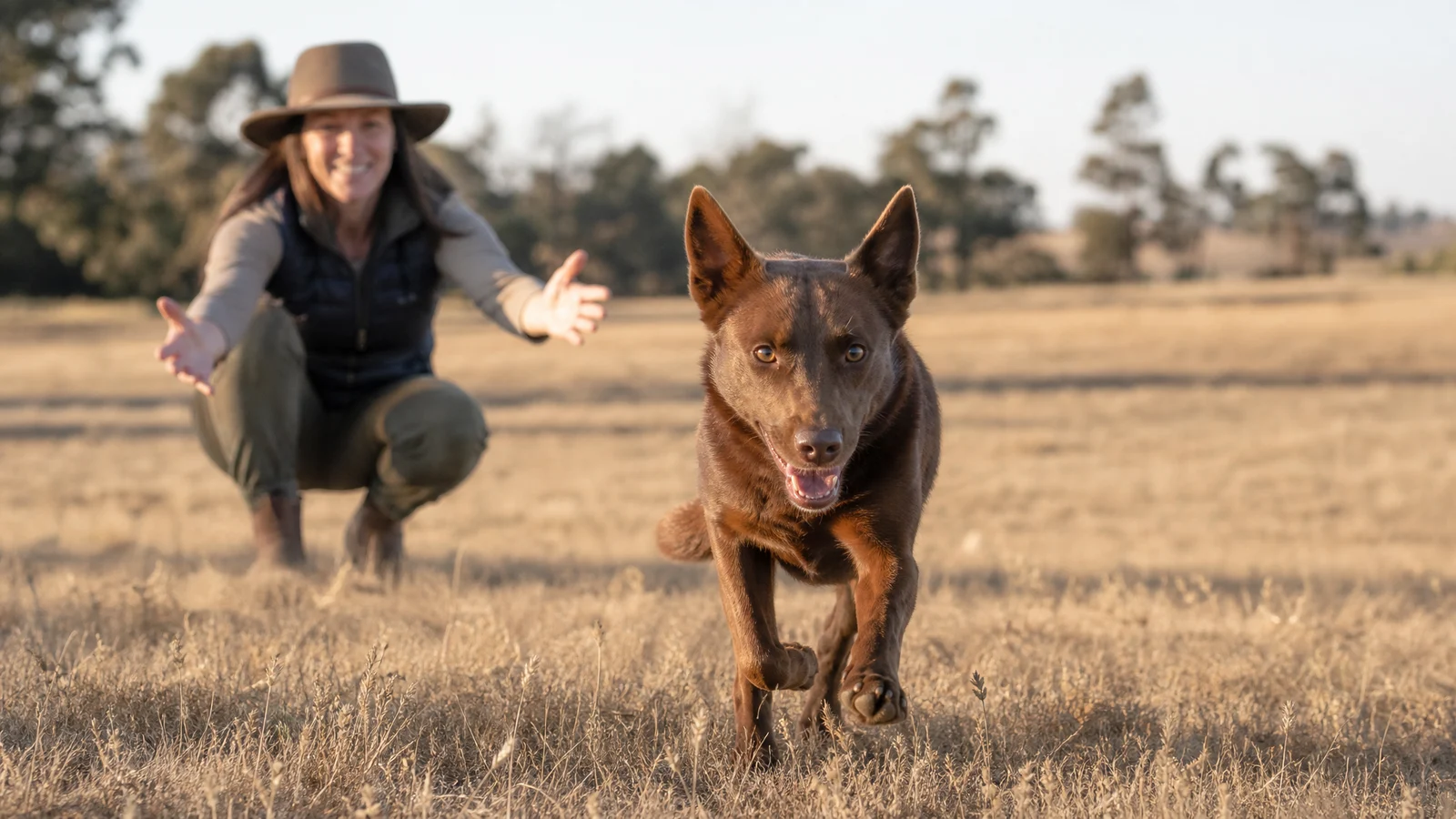
Ordinary recall advice assumes a dog who wants to be near you and only needs a cue and a treat to make it official. The Australian Kelpie was bred for close to the opposite. In the Australian bush these dogs often worked unsupervised and relied on their own wits, so independent choices are part of the training picture, and a plan built for a tag-along dog will underperform.
So the plan changes. Rather than expecting automatic obedience, you make returning the best offer around and manage the moments when your dog could choose otherwise. Handled badly, recall teaches a quick, clever dog that your voice is optional. Handled well, it earns a tireless athlete real freedom.
This guide covers building recall in a Kelpie, from the working history behind their independence and the rewards that can outbid it, to cue choice, long line practice and the problems that crop up, and finishes with a readiness-based field test before more freedom.
The Stock-Work Story Behind Australian Kelpie Recall
Independence here is a working trait, not a flaw in your dog. In the Australian bush, Kelpies often worked unsupervised, relying on their own wits to find and gather livestock. A dog out of earshot cannot wait for instructions, so the dogs who thrived judged a situation and acted without checking in.
That selection did not vanish in pet homes, and Kelpies are still described as keen and active, always ready to work. Their method matters too. Gathering dogs use eye, a fixed stare, along with bark and grip to move stock, so a Kelpie in open country is often locked onto something far from you. The same wiring that makes them superb workers makes a casual "come" feel like an interruption.
What You Will Notice
Expect a dog who scans, picks a target and goes, often in a wide arc, and who may stop being reachable once movement starts. Many Kelpies also bond closely with one person and take a long time to warm to strangers. As a result, recall can be solid for one family member and shaky for everyone else. These are tendencies, not rules, and individual dogs vary.
Reading What Your Dog Means
It is tempting to call a dog who ignores you stubborn, but we cannot know what is happening inside their head. Two readings are common, and they need different fixes. A dog who hears you and carries on is making a choice, so the reward must be stronger. A dog locked onto movement may truly not process the cue, so you need more distance from the trigger.
A quick glance back is a check-in and worth paying for every time. Settling skills help as well, because the breed is meant to balance keenness to work with the ability to rest, and a dog who can switch down is easier to call than one running at full arousal. Our guide to Kelpie crate training and settling covers building that off-switch.
What Recall Has to Beat
The usual script is to call in a cheerful voice, hand over a treat, repeat in the yard until it looks solid, then trust it at the park. For a dog who stays close by nature, that often works. For a Kelpie it tends to stall, because the yard is a boring place and the park is not. Your dog is always comparing what you offer with what the environment offers, and a single biscuit loses that comparison to almost anything that moves.
Temperament matters too. The breed standard describes the Kelpie as extremely alert, eager and highly intelligent, with a mild, tractable disposition, so these are willing partners. Willing is not the same as automatic. One stockman quoted by the Working Kelpie Council says the Kelpie is more of an individual who likes to do their own thing than the Border Collie, and that people who cannot accept this have chosen the wrong breed.
We have trained this breed for many years, and our position is simple: stop treating recall as obedience and start treating it as a negotiation you keep winning. Every return that pays well makes the next one likelier, and every time your dog successfully ignores you, whatever they chose instead pays them. Both effects add up, which is why management matters as much as training.
Australian Kelpie Recall Safety at Distance
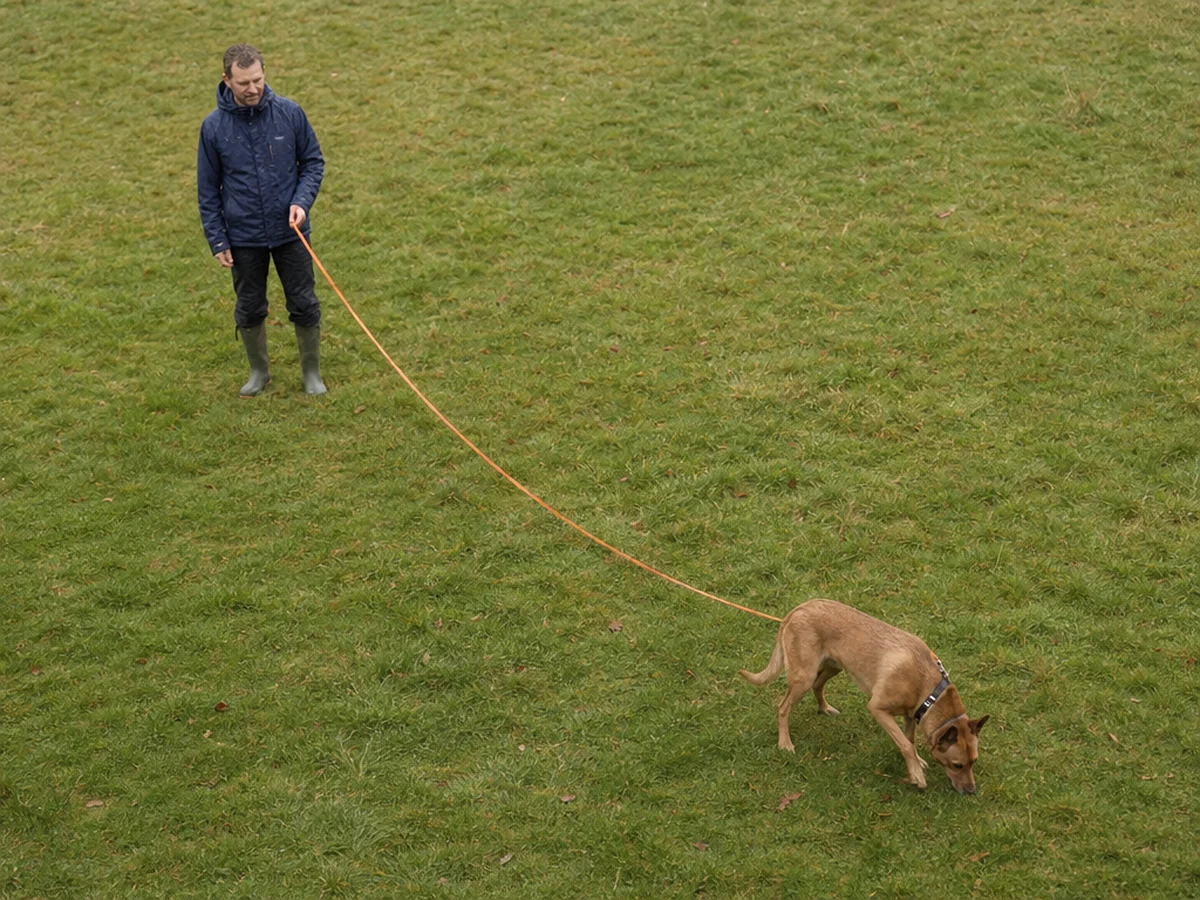
A long line is a light training leash far longer than a regular one, and it suits this breed because it grants distance without granting the right to ignore you. A long training line lets your dog range a fair way while you keep the final say, which is the right balance at this stage. Its job is to stop your dog from rehearsing the habit of leaving.
Gear for the Line
Choose a line that is light and smooth in the hand, and clip it to a well-fitted harness instead of a neck collar so any tension lands on the chest. Heavy rope drags and snags. A thin, wet cord can burn your hands, so wear gloves in open country. Practice somewhere open, away from trees and fences the line could wrap around.
Building Distance in Steps
Raise the difficulty one variable at a time. Change distance, distraction or location, never several together, and drop back a step whenever your dog hesitates. A reasonable order:
- Cue in a quiet room with your dog a few steps away, and pay generously on arrival.
- Repeat in the yard with the line trailing while your dog sniffs, so you practice calling a busy dog and not only a waiting one.
- Add distance gradually until your dog is at the end of the line and still answering at once.
- Move to a new, quiet outdoor place and add mild distractions, such as a distant person or a dropped toy.
- Climb the reward ladder, saving the hardest places for last.
Handling the Line Calmly
Let the line trail or hold it loosely, and let your dog come to you on their own feet. If the cue is ignored, stand still or gather the slack so they cannot go farther, then become the most interesting thing around by backing away, crouching or squeaking a toy. Pay lavishly the moment they turn.
If the line brings pulling on regular walks, our Kelpie leash training for pulling guide helps. Keeping those skills separate makes each session clearer.
Protect the Cue
Your cue is only as good as its history, so decide on it once and protect it. The choices below cover the sound, how often you use it and what it should never be attached to.
One Sound, Shared by the Household
A word like come or here works, and so does a whistle, which sounds identical no matter who blows it or how frustrated they feel. Keep it separate from your dog's name, which should mean only that you want a glance. Make sure everyone agrees on the word, since a one-person dog can learn that only one person's version counts.
Say It Once
Poisoning a cue means teaching your dog that it can safely be ignored, and repeating yourself does it fast. Each unanswered come teaches that the first one was only a preview. If nothing happens, change the situation instead of raising your voice: move closer, back away or make an inviting sound, and pay when your dog arrives.
Keep Arrivals Pleasant
If recall sometimes means a bath, a nail trim or the end of the walk, your dog will learn to hedge. Use the cue for pleasant arrivals, and when the walk ends, call, pay, clip on the leash and sometimes release them to play again.
Three Australian Kelpie Recall Field Notes
Because we specialize in this breed's behavior and training, many of these recall problems may relate to the breed's working background. Sort yours into a theme below, then fix the cause instead of calling harder. Keep up regular vet visits, and if a once-dependable dog suddenly stops answering, mention it to your vet before assuming it is purely a training issue.
Selective Hearing
The dog comes inside but ignores you outside, or answers only when a treat is visible. The cause is usually that the cue was paid only in easy places or only when food showed, so the dog learned a conditional rule. Practice in many locations, keep the treat hidden until arrival, and vary how much you pay while always paying something. If the dog slows, go back down the reward ladder, then climb again.
Circling and Keep-Away
Some Kelpies come partway and then arc around you just out of reach. It looks like cheek, but it probably echoes the wide arc a gathering dog uses to bring stock to the handler. Chasing turns it into a game, so turn and walk away instead, or toss a treat behind you so your dog must pass in front. Teach a hand touch for a treat so that arriving means ending close enough to reach.
Ignoring You Outdoors
Movement and scent can switch a Kelpie into work mode, and in that state the cue may not register. Increase the distance from the trigger, call before your dog fixates, and reward heavily for any look away. Rally builds the same attention, since it focuses on teamwork, not speed. Kelpies in the United States also take part in obedience and agility, which give your dog a purpose for that focus.
What Makes Recall Worth Returning For
A reward only works if it beats the alternative, so rank the alternatives before you choose what to pay. List the places you walk and sort each by how hard it will be for your Kelpie to leave. Then pay at the level of the place, not the level of your hopes. A rough ladder looks like this:
- Easy places, such as your living room or a quiet yard, where ordinary treats are enough.
- Medium places, such as a fenced field or a quiet street, where the dog needs a treat they rarely get or a quick game.
- Hard places, with running dogs, bikes, stock or strong scents, where only your best food or a favorite toy can compete.
Practice starts at the bottom and climbs only when your dog answers fast and happily. Moving up too quickly only rehearses an ignored cue.
Food That Beats the Field
Choose small, soft treats with a strong smell that can be swallowed in a second, so your dog is back to scanning quickly and you can pay several times in a row. Keep the best one for recall only, so it holds its value. When your dog arrives through a real distraction, give a jackpot, meaning a run of treats one after another instead of a single piece. The contrast teaches that the hardest recalls pay the most.
Toys and Play as Pay
Many working-bred dogs value a game above a snack, and the Kelpie's drive to work makes tug and ball natural choices. Keep a toy in a pocket and start the game the moment your dog reaches you. A marker word, a short consistent sound such as a bright yes, pinpoints the moment your dog gets it right, so you can mark arrival before the toy appears.
Movement as a Reward
For a dog whose job was to move, permission to go may be the strongest pay of all. After your dog returns and takes a treat, release them back toward whatever they were interested in. Coming to you then stops meaning the fun is over, which is a common reason dogs start avoiding recalls. A short search in the grass works too, and nose work is a good way to teach an energetic dog to settle their mind on one task.
Field-Test Recall Before More Freedom
Use the sequence below to let your dog succeed on easy repetitions before real distractions enter the picture. The goal is steady reliability, not a rushed test.
- Start by choosing your cue and best reward, then practice indoors and in the yard in short bursts, calling when your dog is mildly distracted and always paying on arrival.
- Once the first step is fluent, add the marker word, hand touch and release back to play, so your dog turns toward you at the cue with an eager look.
- When yard responses are dependable, move onto the long line in a quiet field before trying places with more movement and scent.
- As the locations get harder, pay at the level of the distraction, drop back a step when your dog slows, and have every household member use the same cue.
The lesson that carries beyond this field test is that a dog bred to decide for themselves will keep deciding, so your job is to manage the choices on offer and pay so well that coming back is the one they make. Keep the line on until recall is fast around real distractions, say the cue once, and finish sessions with a scent game or tug. Do that and the Kelpie's independence becomes an asset: a dog who thinks for themselves and still chooses you.
 Puppy trainingKelpie Puppy Chewing Everything? Redirecting Energy Into Rewarded Jobs
 Training basicsWhat Is an Australian Kelpie? Their Working Drive Explained
 Training basicsMarker Training 101: Using a Clicker With a Quick Kelpie