 Kelpie
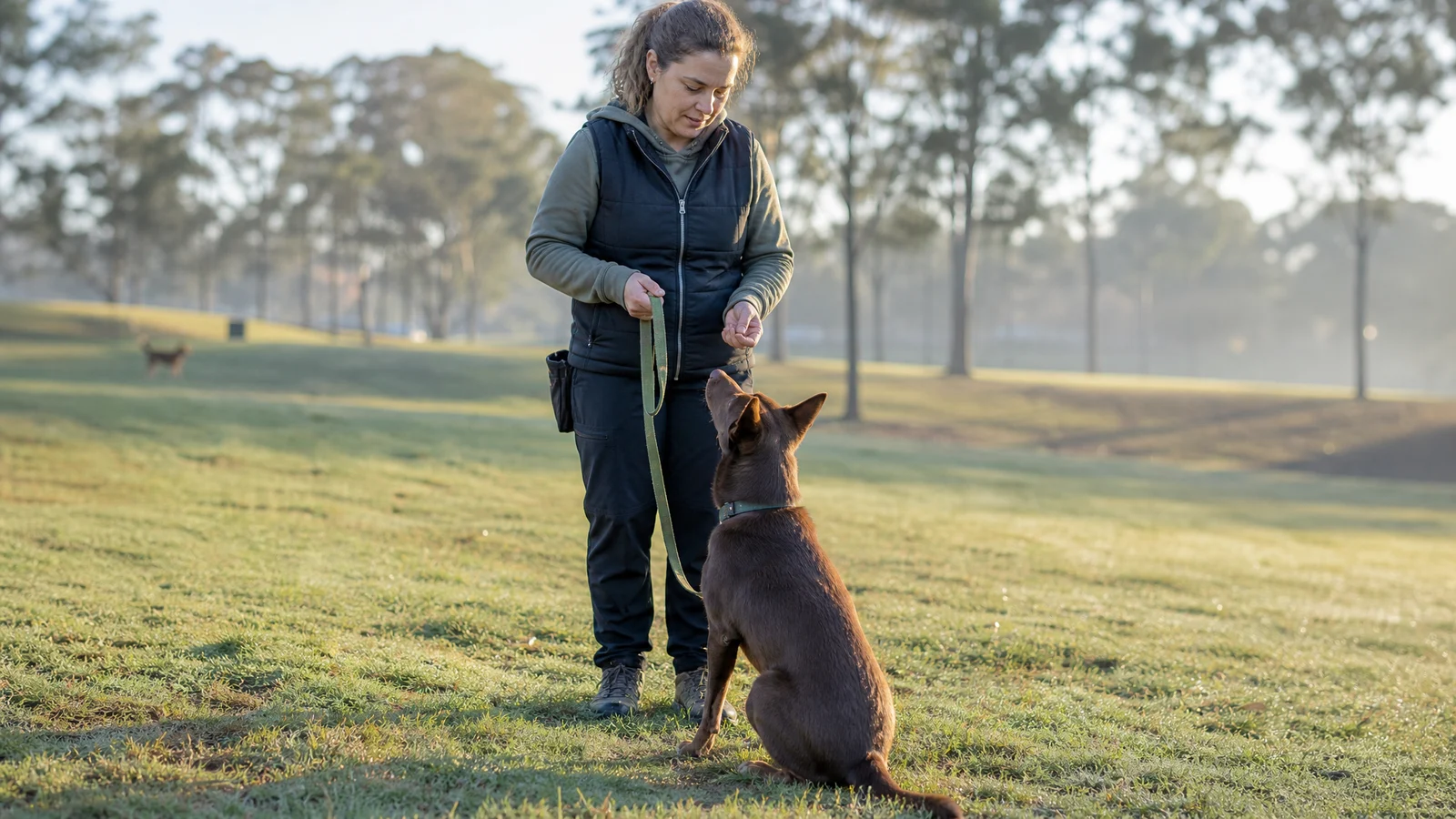
Are Australian Kelpies easy to train? Yes, if easy means they understand a lesson quickly. The answer becomes less simple if easy means they will repeat it anywhere, ignore every competing opportunity, and wait for directions instead of making a decision of their own. A fast learner can recognize a cue and still decide that the environment is more rewarding.
That distinction matters more in this breed than a generic intelligence ranking. Kelpies were developed for useful work, alert to movement and able to act without constant instruction. Their close loyalty can make a familiar handler highly valuable, while their independence makes weak rewards and repetitive drills easy to dismiss. Training feels easiest when it preserves room for initiative inside clear household boundaries.
This article looks at Australian Kelpie temperament as a set of practical training questions. You will learn what tractable really means, where apparent stubbornness comes from, how barking and chewing fit the picture, and which signs show that your approach is working.
Australian Kelpie Temperament at a Glance
Breed accounts put several traits together: alertness, eagerness, intelligence, a mild disposition, loyalty, and lasting work energy. Together, they describe a dog who notices fast, learns readily, bonds closely, and expects useful work. Alertness tells you the dog will register small changes. Eagerness tells you they are ready to engage. Neither says what they will choose when a moving target competes with you. No single adjective guarantees effortless manners.
Intelligence Versus Compliance
Intelligence is the ability to notice patterns and solve a problem. Compliance is the willingness to follow a familiar cue in the moment. A Kelpie can have plenty of the first and withhold the second because a moving bike, an open gate, or an interesting smell offers a better outcome. The practical response is to lower the competition while the habit is young, then build difficulty deliberately. Repeating the cue at full difficulty only rehearses ignoring it.
That is not a contradiction.
The Meaning of Tractable
Tractable is best read as responsive to good handling, not passive. A dog with a mild disposition can still be intense about work and selective about strangers. The handler makes the requested behavior clear, rewarding, and realistic in the setting where it is asked. Begin a recall in a quiet room, moving to the yard on a line, and only later asking near fast movement. The dog is learning the cue across contexts rather than being tested without preparation.
Our position is that the breed is easy to teach but not automatically easy to manage. Fast learning reduces repetition. It also means accidental lessons, such as barking to start a chase or stealing an object to gain attention, can become efficient habits.
Are Australian Kelpies Easy to Train?
They are usually quick students when the lesson has a purpose and the reward matters. Training becomes harder when it is long, vague, or disconnected from what the dog wants. Think less about proving control and more about arranging a choice whose best answer is to work with you. A sit before a door opens, a check-in before release to sniff, and a mat settle before a game resumes all connect behavior to a result the dog understands.

Fast Learning in Daily Life
A Kelpie may learn a hand target, mat, or check-in after very little practice, then appear to forget it outdoors. The cue did not vanish. The context changed. Dogs do not automatically generalize a lesson from carpet to sidewalk, or from a quiet yard to a place where other dogs run. Return to a quieter distance, pay more generously, and rebuild before expecting the kitchen response beside movement and noise.
Quick learning cuts both ways.
Independent Decisions
The working-breed perspective describes the Kelpie as more inclined to do their own thing than a dog bred for push-button direction. That independence was useful when livestock work demanded judgment away from a handler. In a home, it means prevention and meaningful alternatives matter more than repeated commands.
If looking out the window, patrolling the yard, or circling another dog is self-rewarding, a small piece of ordinary food may lose. Increase distance from the distraction, shorten the task, and reward attention with something the dog actually values, including play, movement, or permission to sniff. Management closes the gap while training catches up. A covered window, a gate, or a line in a safe yard prevents the old choice from paying outside active practice.
One-Person Loyalty
Close loyalty can accelerate training with the primary person and expose gaps with everyone else. A cue is not finished merely because one family member can get it in one room. Practice with different people, in different safe places, while keeping the words and reward rules consistent. Let the other handler begin with rewarded skills rather than taking over at the hardest moment. Success builds a working relationship without forcing social enthusiasm.
A reserved dog does not need to greet every visitor to prove trainability. They do need a predictable way to settle, move away, and take direction when unfamiliar people are present.
Does Kelpie Temperament Create Problems?
Temperament creates tendencies, not a fixed outcome. Alertness can become observation or constant alarm. Energy can support work or fuel a patrol. Independence can produce problem solving or a dog who stops consulting you.
Barking and Alertness
First identify what starts the barking. The barking guidance recommends working from the cause rather than treating every bark alike. For window alerts, reduce the view, reward naturally quiet watching, and teach a mat away from the glass. If the dog barks because an exciting activity has stopped, wait for a quiet pause before restarting it. Our guide to Kelpie behavior problems separates alerting from herding patterns and fear.
Silence is not the only success. A dog who notices, checks in, and settles again is showing better control than one who stays quiet only because nothing happened.
Chewing and Idle Energy
Chewing is normal dog behavior, and boredom can make the wrong targets more attractive. Chewing advice favors redirecting the dog to suitable items and meeting exercise and play needs. Put legal options where mistakes happen, manage access, and reward the switch. A dog who repeatedly finds shoes while every toy is stored elsewhere is practicing the available answer, not displaying a difficult personality.
For puppies, teething also changes what the mouth needs. The puppy teething timeline places the loss of baby teeth around twelve to sixteen weeks and the adult set around six months. Those supported ages explain a phase, not every chewing event. Regular veterinary visits help you distinguish a training issue from discomfort or a sudden behavior change. Do not assume that every destroyed object is a statement about temperament.
Training Methods for Kelpie Temperament
The best method turns the breed's speed and initiative into cooperation. Set up a clear task, mark the correct choice promptly, deliver a reward the dog values, and finish before attention falls apart. Structure is not the opposite of reward-based training. It tells the dog where success can happen.
Rewards That Hold Attention
Food is useful for quick repetitions, but it is not the only currency. A Kelpie may work harder for a thrown toy, a short tug game, permission to search, or release to move. Test rewards in easy settings, then reserve the best option for the hardest environment. Value also changes through the day. Food may matter before a meal, while movement may win after rest, so watch the dog's choice rather than relying on a fixed ranking.
Pay voluntary attention. A glance back on a walk is worth marking because it is the beginning of a dog who consults you before acting. The site's complete Kelpie training guide explains how to make those check-ins more valuable than the dog's private plan.
Short Sessions With Structure
A productive session has one goal and a visible finish. Practice a few good repetitions, release the dog, and return later. Longer work is not automatically deeper work, especially after the dog begins scanning, slowing down, or inventing a different game. Ending while the dog remains engaged protects eagerness for the next session and prevents sloppy repetitions from becoming part of the skill.
Use this compact test before raising difficulty:
- The dog can perform the skill in the current place without seeing the reward first.
- They recover promptly after excitement and can offer attention again.
- You can name the next single challenge, such as more distance, duration, or distraction.
- The dog still looks willing when the session ends.
Consistency Across the Household
Agree on cue words, door rules, greeting rules, and what earns release. If one person rewards jumping while another asks for paws on the floor, the Kelpie is not confused about intelligence. They have learned that the people run different systems. Write the small rules down if needed, especially for visitors and children, so the dog is not asked to solve a new social puzzle every day.
Consistency should make life legible, not rigid. Adjust reward value and difficulty for the person handling the dog, while keeping the desired outcome the same.
Signs Your Kelpie Training Is Working
Progress appears first between formal cues. Your Kelpie checks in before chasing movement, returns attention after a distraction, goes to a resting place while the household stays active, and can work with several trusted people. They remain lively and observant, but personality no longer runs every decision. Prompts should also decrease as the dog learns how to earn the next opportunity. That pattern matters more than flawless performance in a single quiet session.
Get help when fear, growling, snapping, frantic behavior, or a sudden change makes ordinary management unsafe. Start with your veterinarian to rule out health factors, then work with a qualified reward-based professional who can observe the setting and design a gradual plan.
So, are Australian Kelpies easy to train? They are fast to teach and demanding to guide well. Respect the independent judgment, reward cooperation, and measure success by voluntary attention and recovery. That is a fairer test of trainability than instant obedience. It preserves the alert, eager worker described in the breed material while making that initiative safe, understandable, and useful in an ordinary household.
 Puppy trainingHow to Train Australian Kelpie Puppies Week by Week to Age Two
 Exercise and jobsAustralian Kelpie Sports and Jobs for Their Instincts
 Training basicsHow to Train an Australian Kelpie Who Does Their Own Thing